
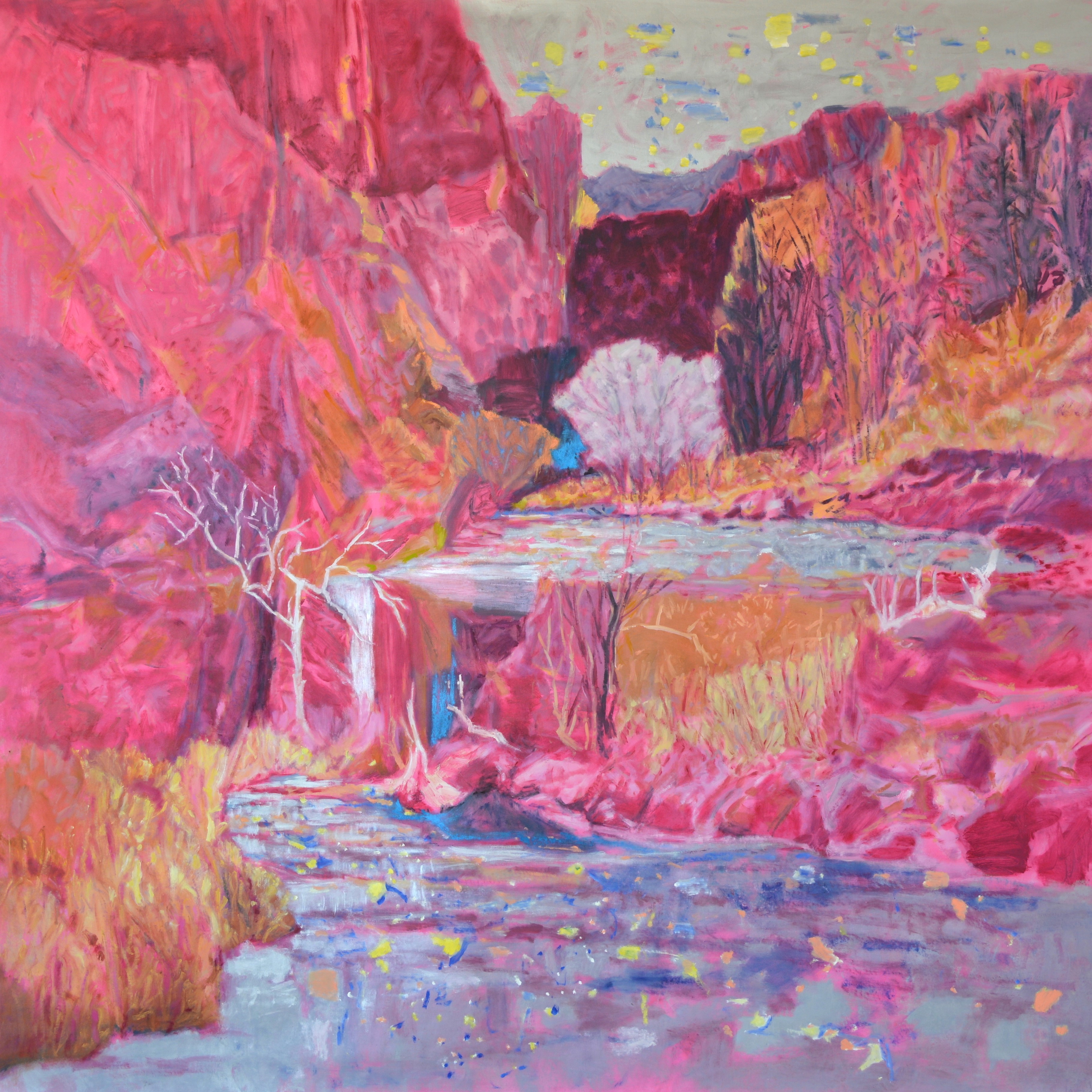
Jo Bertini, Breath of the Last Wild River, 2022, iridescent pigments and oil on French polyester canvas, courtesy of the artist
Jo Bertini’s canvases are multi-hued constellations, with passages of paint that shimmer like sunlight on a body of water. One can imagine light catching the tiny crests of painted ripples and bouncing across the surface of the painting to be gratefully received by the viewer. After all, what does one do when in the presence of the sun but be warmed by it.
Living in and with desert landscapes has shaped Jo’s way of being in the world and heightened her sensitivity to the colours, forms, and nuances of the desert. The way she understands and shares her encounter with ancient desert lands begins with deep listening and sustained looking. Sitting quietly for long periods, drawing and painting both on country, under the sky and in the studio – Jo’s painting practice speaks to me of a deep-seated yearning towards belonging and connection.
I commenced my relationship with Jo’s work when she was the Artist in Conversation with Maria Stoljar, of the popular podcast series Talking with Painters, at the Art Gallery of New South Wales in October 2022. In the following week, I deepened my relationship to her work by viewing Jo Bertini, Deep in the Land, at Arthouse Gallery in Rushcutters Bay, where I serendipitously bumped into Jo and her musician husband Thomas. At the Gallery I was made very welcome by Jo herself, and Arthouse Gallery Director, Ali Yeldham, and Gallery Manager, William Mansfield. I spent a wonder-filled lunchbreak building a more nuanced and intimate relationship to this body of work inspired by the high desert country of New Mexico.
During that journey I started to think of Jo’s canvases as portals into alternate ways of viewing the world and equally, as luminous, visual evocations of string theory. String theory, which I first encountered by listening to astrophysicist Brian Greene in conversation with Richard Fidler, is an important, evolving, theoretical concept that allows us to think about every element in the universe within the one theory. Put simply, string theory states that everything in the universe is made up of tiny strings vibrating at different frequencies. The idea that humans and nature, objects, fauna, flora, and geological elements such as mountains and rivers or silica infused stones that fit inside your hand are discrete, separate entities is a false conceit of human exceptionalism. In a remedial bid to bring balance back between diverse human and non-human elements in the world, scientists, and post human cultural theorists and creatives are insistently deconstructing the notion of human exceptionalism, a concept based on enlightenment thinking that placed a projection of the perfect human as the centre of the universe. String theory profoundly disrupts any hieratical classification of human and human or human in relationship to any other element in the universe.
Across her painting life, Jo has been the artist on country for multiple scientific and cultural expeditions and articulates a deep and sustained respect for Indigenous people and practices both in New Mexico and in Australia. Jo’s paintings are an ethos rather than an instruction booklet of how to be in the world – they vibrate at the same frequency as the desertscapes she paints, whilst sensorially engaging with the land in a way that recognises the symbiotic nature of human’s relationship with each other and the world. We don’t inhabit the world as a singular entity – we are of and with the world and of and with each other on this journey. The well-being of the world and of all other entities is indivisibly enmeshed with our own well-being. Living and working between the dry arid central desert regions of Australia and the high desert country of New Mexico, Jo’s temporal practice of being in and with the landscape allows the intimacy of her relationship to the land to shape the subsequent mark making born of that relationship. Gesture after gesture, layer after layer, breath after breath infuse the painting with a life force, as paint and canvas become a living, breathing, cosmology of marks and gestures – based on connection, not disconnection, coherence not dissolution, belonging not alienation. Jo’s paintings remind us to return to awe as a foundation principle when engaging with the natural environment.
Modernist utopian ideals saw early and mid-twentieth century Australian artists strive to create artworks whose underlying compositional rhythms corresponded with the larger rhythm of the universe. Abstract artworks by artists such as Grace Crowley and Ralph Balson, were underpinned by a sense of the fusion of unseen energy corresponding to universal rhythms (Denise Mimmocchi, Senior Curator, Australian Art, Art Gallery of New South Wales, 2022). These early modernist, painterly and intellectual aspirations resonate for me with how Jo’s works engage with the desert as a distillation, a return to source, a search for the universal frequency. Each painting gestures towards a reverential engagement with the land seeking to find its own connection to universal rhythms. Accompanying Jo’s paintings are discreet captions (small font, hung low) that operate like a double helix with scientific, geological, and autobiographical narrative strands threading through and around the work. The text-based offerings further draw out themes of environmental vulnerability, these paintings are calls to action: to notice, to honour and to protect.
Postscript: The body as landscape
During the Artist in conversation, Maria and Jo spoke about only one portrait – Jo’s portrait of her mum, painted during her mother’s journey with dementia, titled, Annie – remember me if I forget (Anne Ferguson) and hung in the Portia Geach Memorial Award, 2021. This work has the same yearning towards belonging and connection that I mentioned earlier in this essay in reference to Jo’s landscapes paintings. I see the same reach towards understanding, the same intimate, sensitive rendering of the landscape of her mother’s form – whose sentience was devolving into something more mysterious, more mythic, less easily known. Being witness to one’s mother’s journey with dementia, elevates one’s sense of vulnerability reminding us, as it does, of the ever-widening distance from our infant sense of our mothers’ as being the whole world: the source of nourishment and reason. Our mothers anchor us in flesh and in memory, in ways that become so intrinsic to who we are that we forget the visceral world-making and positively mythic nature of the mother child relationship. A relationship we eventually take for granted along our life’s journey … until … one day it is no longer there. Even fractured relationships with mother’s are grounding and centring. Mothers are part of our orbit as we are part of theirs, materially, psychically, and metaphorically. We are part of them, and they are part of us … always and forever. During the time of making the painting of her mum, when her mum’s mind was wandering, there were moments which Jo described as: her mother’s mind settling into coherence, so that briefly her mum would return, alight for a moment like a sparrow on a twig, beautiful, complete, irreplaceable, and impermanent – as we all are.
Settling into coherence is an apt phrase to describe Jo’s painting practice and its relationship to the landscapes she paints. Layers of paint wash across the canvas, thin enough to reveal what went before – pink underpainting warms the final layer, textured passages are scumbled across the canvas, your eye encounters them like the bristly textures that bare hands and feet might encounter in the desert. Bare canvas is repeatedly visible as your eye travels across the picture plane – like sandy passages in a dessert, never empty, just holding space differently, discerningly. Gestural abstract marks informed by a multi sensorial relationship to place, with palettes that responds to both mood and season offer us an awe-filled invitation: to step through the portal into deeper encounters with the essential ecologies of desertscapes as a form of life support.
Jo’s paintings pay attention, tending the wound of separation and loss. They are a form of first aid for the soul.
References
Brian Greene, ‘Untangling the physics of string theory’, Conversations, ABC 20 March 2018, https://www.abc.net.au/radio/programs/conversations/conversations-brian-greene-rpt/9545248
Denise Mimmocchi, Senior Curator, Australian Art, Curatorial talk, Modern 20th Century Galleries, Art Gallery of New South Wales September 2022
 How to start a love affair with art
Dear Naomi,
Jo Bertini’s 2022 painting entitled “Breath of the Last Wild River” is so vibrant, dynamic and eye-catching. Thank you very much for championing her work so commendably well. I often have a particular affinity with the abstractions depicted in paintings of Jo Bertini, Grace Crowley and Ralph Balson. This one reminds me of some of my large quartz clusters on display in my living room.
It seems that we have a number of things in common, namely, our love of art, and perhaps even our promoting other artists, either by championing them and/or critiquing their works. Also, as a lover, collector, composer and connoisseur of art and music, I like to think about and comment on art when time permits and circumstance prevails. You can see an example in the multimedia post of mine promoting the works of John Clinock is entitled “🦅 SoundEagle in John Clinock’s Art Rat Cafe 🎨🖼“, in which I have made a detailed analysis on the techniques used in abstract painting. The direct link is available at
Happy Sunday to you!
Yours sincerely,
SoundEagle