
I met a girl in January 2023, I thought she told me her name was Paris. I met her at an artist talk at Articulate Project Space, in Annandale, Sydney. Paris along with Georgia Pea – whose name really is Georgia, co-curated the group show, Everything is Different, on exhibition 7 January – 5 February.
Paris as I’ll continue to call her for a while, until reading the room sheet corrects me, was both a curator and an exhibiting artist. I find it reassuring that I am open to correction – some people aren’t. Paris’ s work, Items of hope and disappointment: expired inspiration (series) 2023, was made of found objects. Items that prior to being vacuum sealed into plastic bags, along with black acrylic paint and suspended from waxed cotton strings, had been lovingly collected (I imagine) and carefully stored in her studio (she told us) awaiting their reincarnation and transformation as part of an artwork. The wires that held the transparent bags aloft made a pleasing formal composition of V shaped straight lines. The odd everyday objects, shrink wrapped inside the clear plastic, become elegiac in their suspended and still transforming state as the paint, ever so slowly, continues to move.

Items of hope and disappointment: expired inspiration (series) 2023 (detail)
Paris recounts play as being central to her creative practice, a process she found difficult during the creation of this work as she had recently had two debilitating, impactful experiences, a shoulder dislocation, and the loss of her father, who I surmise from her talk was an active and affirmative part of her life and her creative practice. Both wounds manifesting in differently impactful ways.
Audience member and poet Harry Seely, shared during the talk that when he came into the gallery earlier (the works are near the front door) he felt the urge to stand behind the work and blow on the suspended bags. Paris recounted that, ‘in reality they are objects that have had all the air removed from them – they are breathless.’ Harry’s urge was a playful gesture, which held within it a more profound offer – the potential of breath to animate and reanimate objects and ideas. For me, breathing and suffocating, action and inaction, life and death are explicitly and metaphorically the subject of this work. This work led me to think about how the words that we offer are formed in collaboration with our breath and carry the potential to become our legacy as they coalesce into conversations. Exchanges which whilst often ephemeral, can sometimes create a lifetime of impact. Thinking about how words are made of breath leads me to think about the intimacy of their creation and the potency of their release – on the giver and the receiver.
The tension between the formal qualities of the cotton strings cutting through the space in an elegantly repetitive, engineered fashion and the oddly beautiful, yet slightly abject quality of the objects in their airless, plastic pockets – created an aesthetic dissonance that evoked for me: the sadness of unfulfilled promises … a feeling of ennui … an evocation of a state of melancholy … a profound sense of disappointment as the found objects cut free from their purpose seek to reorientate themselves to their new place in the world. I find it breath-taking when I hear my emotional response to the work and my recent state of mind, suspended in the title, Items of hope and disappointment: expired inspiration (series) 2023. I too, recently lost a parent, my mum died in May last year, and I am still in the process of bereavement. I wonder what made me particularly receptive to honouring this specific work, one Sunday afternoon at an artist run gallery on the edge of Parramatta Road. Is it my recent wounding that made me more open to the work or was it Paris’s words that brought me closer. Or, equally possible, was it the thoughtful and generative conversation I had with Harry before the artists talk began that allowed me to honour the exchange with my attention. I have written previously on Joan Retallack’s concept of poethics, that suggests that some ideas can be most ethically reached towards through creative forms, and that these forms are singular and irreducible and ultimately ungraspable in their entirety. Is it the challenge of drawing moving fragments into creative forms that helps us to approach and remain alive to … ideas that matter. Indeed, Retallack suggests that some ideas cannot be expressed any other way than creatively, be that in poetry, visual art, music, or the dramatic arts, (Link to my previous essay on Poethics)

Items of hope and disappointment: expired inspiration (series) 2023 (detail)
A poem for my parents
I am mute though
I can’t stop talking
Unmoored from my reason why
I am cast adrift on the ocean
Slowly dispersing
I am everywhere but nowhere at all
As you slowly slip away
I know. One day you will die
And I will still be here
Bobbing around
deafened by my own loss
That began the day I was born
Blessed to be a Grace note
in other people’s lives
Until one day
I’m not.
I wrote this poem some time ago, as both my father and mother (no longer together) began slipping into their own differently manifested, slowly evolving dementias which surprisingly, for different reasons, offered me some of the loveliest exchanges I’ve ever had with each of them. In my poem I originally had the word Condemned rather than Blessed to be a Grace note in other people’s lives. I am still not sure where I sit on the continuum between blessed and condemned. I am prone to emotional over reactions.
To return to my earlier mistake:
Paris’s name is Paraskevy Begetis. Paras for short. The word Paraskevi with an ‘i’ is Greek for Friday and means to prepare as in prepare for the sabbath. I’m not sure there is any real way to prepare for the loss of a parent, of course there are practicalities, but these are not the elements that trip us up at unexpected moments – where one can go from robust to bereft in a heartbeat. Where the emotion of grief is experienced as profoundly carnal and … humbling.
I suspect, Somewhere between hope and disappointment: expired inspiration, is where many of us live, at least for a while, particularly those with sensitive souls and tender hearts. I am offering the quote below from physicist, Professor Brian Cox as a salve to the ennui that sensitive souls sometimes suffer.
The ingredients in our bodies were assembled in the hearts of long dead stars over billions of years and assembled themselves spontaneously into temporary structures, that can think and feel and explore, and then those structures will decay away again, and at some point, in the very far future there will be no structures left.
So, there we are, we exist in this tiny little window that can observe this magnificent universe. Why do you want any more? The real treasure is in that journey of trying to face the incomprehensible. It’s in that realisation that it’s almost impossible to believe we exist! That’s a wonderful thing. Don’t try to simplify things because you don’t want to face the infinity that’s right there in front of us, or you will miss the beauty of it….! Brian Cox in conversation with Joe Rogan on The Joe Rogan Experience.
For me, Everything is Different, has a vein of mortality running through it, like the Dutch tradition of vanitas, where artists offer us scenes of exquisite beauty such as glorious flowers, in elegant vases and then add a memento mori, (a reminder of death) such as a skull to remind us that beauty will fade and death will find us all. Tammy Brennan, for //transcript//, recorded a performance as she was set alight whilst wearing a flame proof suit, in a highly cinematic, compelling video work with original audio. Erica Izard made Contemplation, a quiet series of works using family photographs transferred onto glass, which she described as a coming-of-age work, a heartfelt declaration especially, once one learns that Erica is in her fifties and the coming of age refers to her recent experience of her mother passing away. I suspect some element of all of us remains a child, until our parents pass, and that when the parental body no longer stands between us and the grave we are forced to recalibrate. It may be that I am particularly sensitive to stories of loss, but it is also quite likely that after the last few years – we all are.
I am continuing to consider what the act of witnessing requires of us (Link to my previous essay on Witnessing) and curiously getting Paras’ name wrong is another not insignificant example of my past shaping how I receive the present, my ears being accustomed to receiving the word Paris, the city of love, rather than Paras as a diminutive of Paraskevy, with its Greek heritage. The challenge is: How can one be an effective witness when one’s past so effectively filters what one receives?
Articulate’s series of artist talks and indeed the exhibition, Everything is Different gave me a lovely opportunity to think about the world making qualities of art-framed encounters. In the words of American Professor Emerita in the History of Consciousness Department and Feminist Studies Department at the University of California, Donna Haraway,
It matters what matters we use to think other matters with; it matters what stories we tell to tell other stories with…
I so agree with Donna… do you?
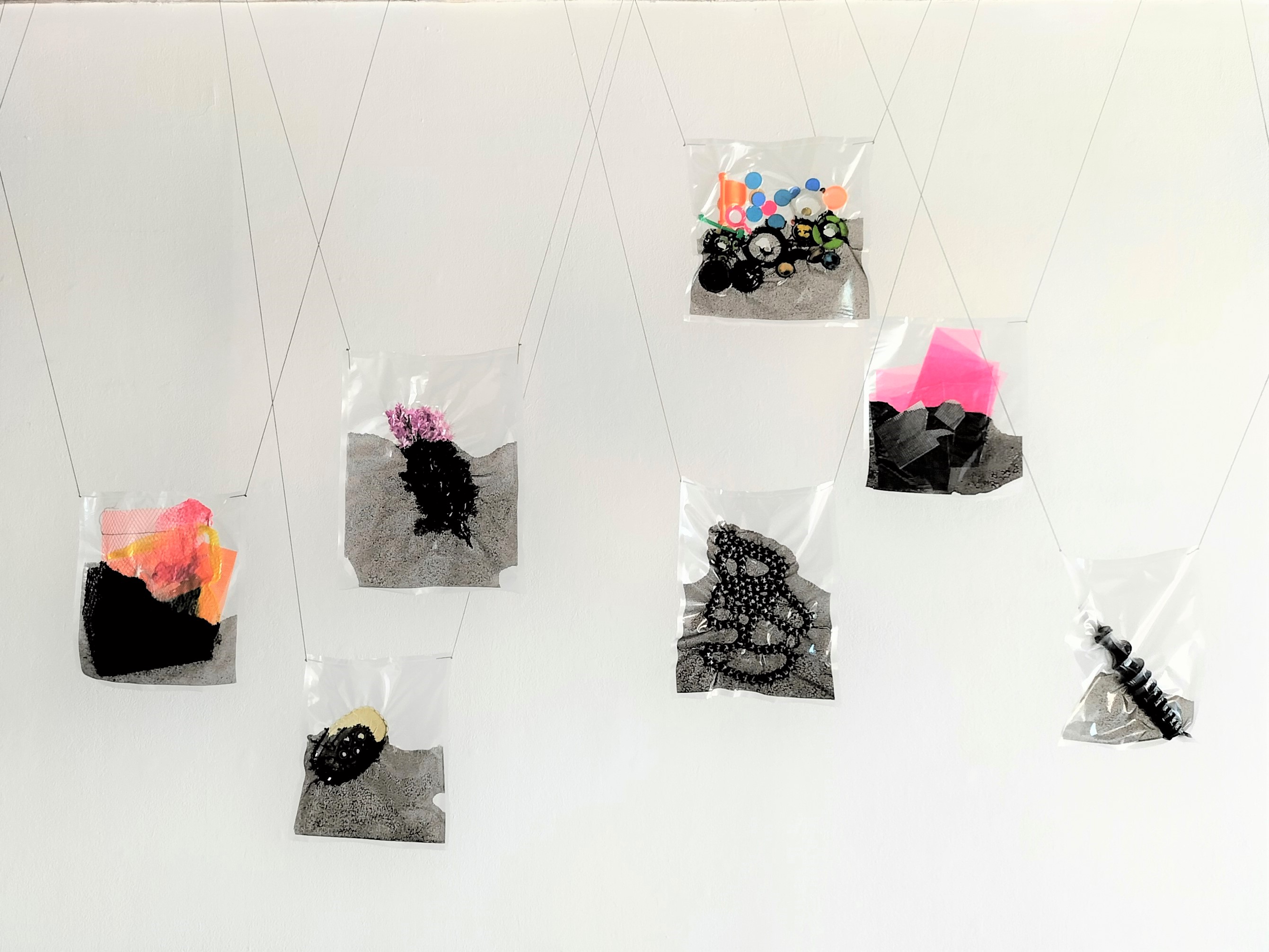
Paraskevy Begetis, Items of hope and disappointment: expired inspiration (series) 2023 (detail)
 How to start a love affair with art
Very poetic! I enjoyed (I don’t know if that’s the right word though, more like scared) the observation, ‘I suspect some element of all of us remains a child, until our parents pass, and that when the parental body no longer stands between us and the grave we are forced to recalibrate.’ – though I have not gone through this, I suspect you are right!
I did also enjoy Brian Cox’s quote and how you worked it into the narrative.
The point about witnessing is also apt, I think. Especially so because I believe our memories are not always accurate depictions of events, because the ones we remember most vividly are those that were the most emotional, and those are the ones I think that lend themselves to being the least objective.
I think also sometimes that our view of the world is hardly as objective as we imagine – a lot of what we see is interpreted by our brains in different ways. For a particularly vivid example of this, see this article: https://www.theguardian.com/education/2012/nov/12/improbable-research-seeing-upside-down
As always, lovely article!