
Tags
Joan Retallack’s word poethics, which is a combination of the word poetry and ethics, suggests that some ideas can most ethically, be expressed artistically. Poethics suggests that creative expression and the inherent doubts that occur during its making and its reception are part of an ethical endeavour that is contingent and relational. Poethical encounters are not didactic, rather they operate best when both sides of the encounter are offered as an open invitation to engage. Poethics reminds us that the meaning/s we ascribe to objects and experiences are always evolving and just like memories, will be reshaped depending on the context of their gestation and retrieval. Perhaps it is the earnest reach towards understanding which creates the conditions for an ethical life to occur. This is likely a poethical definition of poethics.
Scene One:
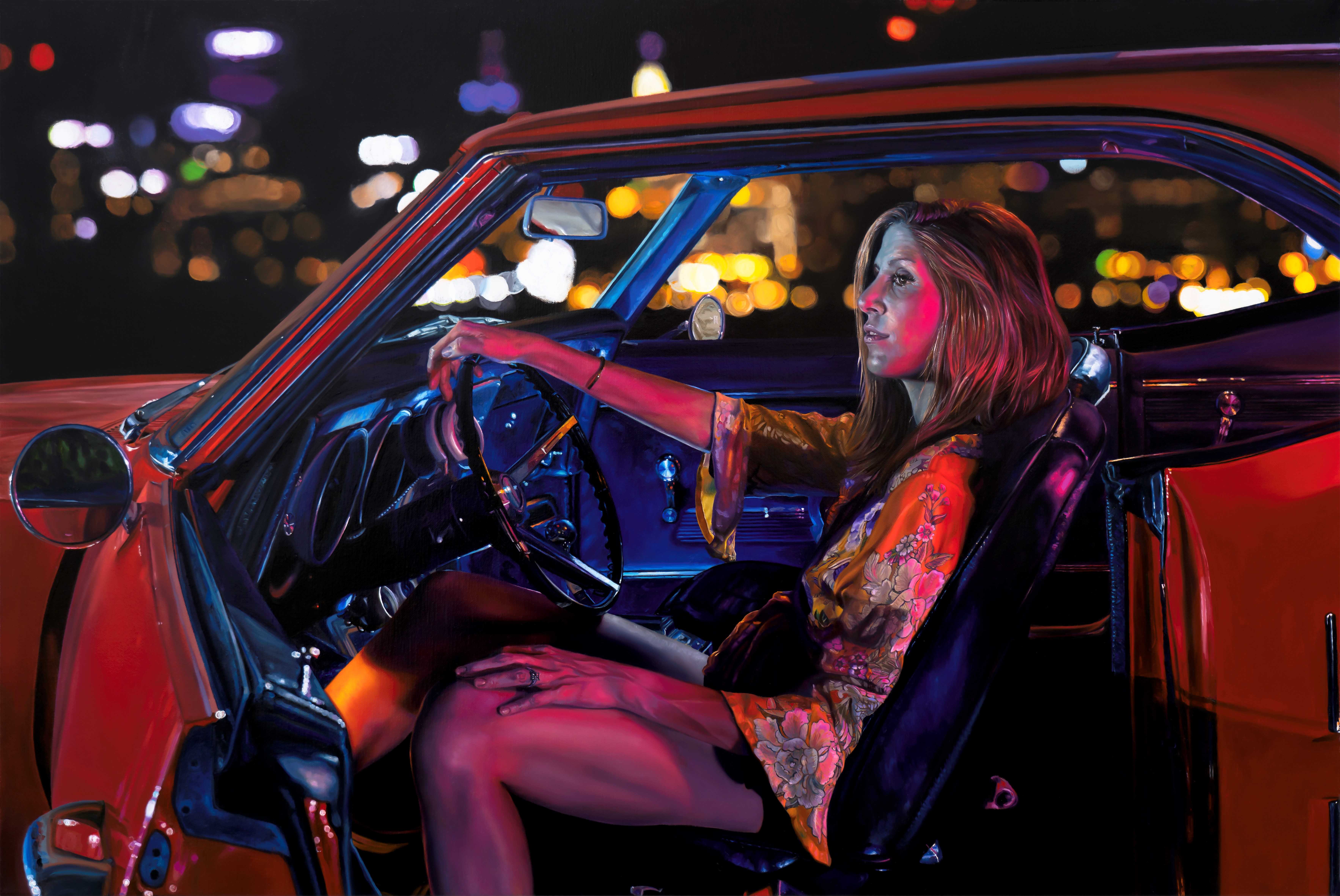
Dianne Gall The future is not ours 2022 Oil on Linen 51x76cm Image courtesy the artist and Nanda Hobbs Gallery, Sydney
This essay starts with a consideration of Dianne Gall’s exhibition, Forever Now, at Nanda Hobbs Gallery, Sydney, in November 2022. Forever Now, consists of a series of four small paintings featuring single, female-presenting subjects. Subjects so immobile that apart from the sheen of sweat on their faces, they could be mistaken for mannequins. Galls’ women wear lusciously patterned, wrinkleless dresses over improbably perfect bodies. Each one gorgeous in their glamorous attire, located in equally luscious settings, Gall simulates the bokeh photographic effects of having a narrow depth of field, with out of focus backgrounds that keep the subjects sharply in focus. Cropped and contained – I read these women as sentinels.
This is beauty with an undertone. Light, form and colour, all expertly and exquisitely handled by Gall, are deployed to create elegant paintings with suspended narratives as each subject plays silent witness. Controlled as these scenes are – it is the intimate encounter with heat, evidenced through the sheen on the women’s faces, that interests me the most. This is the heat of a body that pulses regardless of the cool perfection demanded of it. It is the heat of resistance. These exquisite paintings with their glass-like surfaces and intense observation of the effects of light, collude with their subjects to present constructed, emotionally restrained, scenes of deep ambiguity.
I read these images as beauty as carapace, withholding the interior self from scrutiny, effectively executing a practice of hiding in plain sight. These are studies in beauty as armour, camouflaging interior landscapes that are undoubtedly … messier.
Dianne Gall is quoted as saying ‘Less is more, and quality is all’. To pluck a sentence out of context is a risky act, but not one I am averse to doing. With all extraneous detail removed from these pictures, the ‘less is more’ epithet appears literal. ‘Quality is all’, dovetails into my reading of the subtext of these works, a design dictum intended to eradicate the messy human complexity of life lived forward – erratic and unpredictable, as opposed to designed backwards – paired down to a closed set, with a cast of one, and a ruthless wardrobe mistress and vigilant location scout. I read Gall in the tradition of the auteur whose directorial eye is cast over every part of the creative endeavour, although at this point in my relationship to Gall’s work this is speculation. Does she ask her subjects how they want to pose, are the locations invitation and collaboration? Important things to think about in a timely and unhurried way whilst also giving the work the dignity of time to envelop me in its contradictory complexities.
These works freeze frame a moment, a temporal beat pregnant with potential. In the painting, The future is not ours, Gall places the subject inside a car … creating a scene evocative of 1980s road movies, where petrol guzzling cars are somehow the key to the survival of humanity. The car as escape vehicle, as power, as control over one’s destiny. The future is not ours, has a close-cropped composition, containing the subject inside the vehicle – although the door is open. The future is not ours, reads like a film still, with its aesthetic roots in modernism’ adoption of the cropped image born from the now ubiquitous practice of viewing the world through a lens. Viewfinders and lenses are mechanical apparatus that practically facilitate agential cuts (Barad, K. 2007), slicing the world into that which is within the frame and that which we place outside of it. That which we wish to see and that which we wish to ignore. Even though we know there is more beyond the frame and beneath the surface, viewfinders help make the constructed view we create seem natural, even inevitable.
Engaging with Gall’s work is a perplexing pleasure. These works are so lusciously and gloriously rendered, that for me that seduction is a given. However, someone once said to me silence is power but only when chosen for the self…
Scene Two:
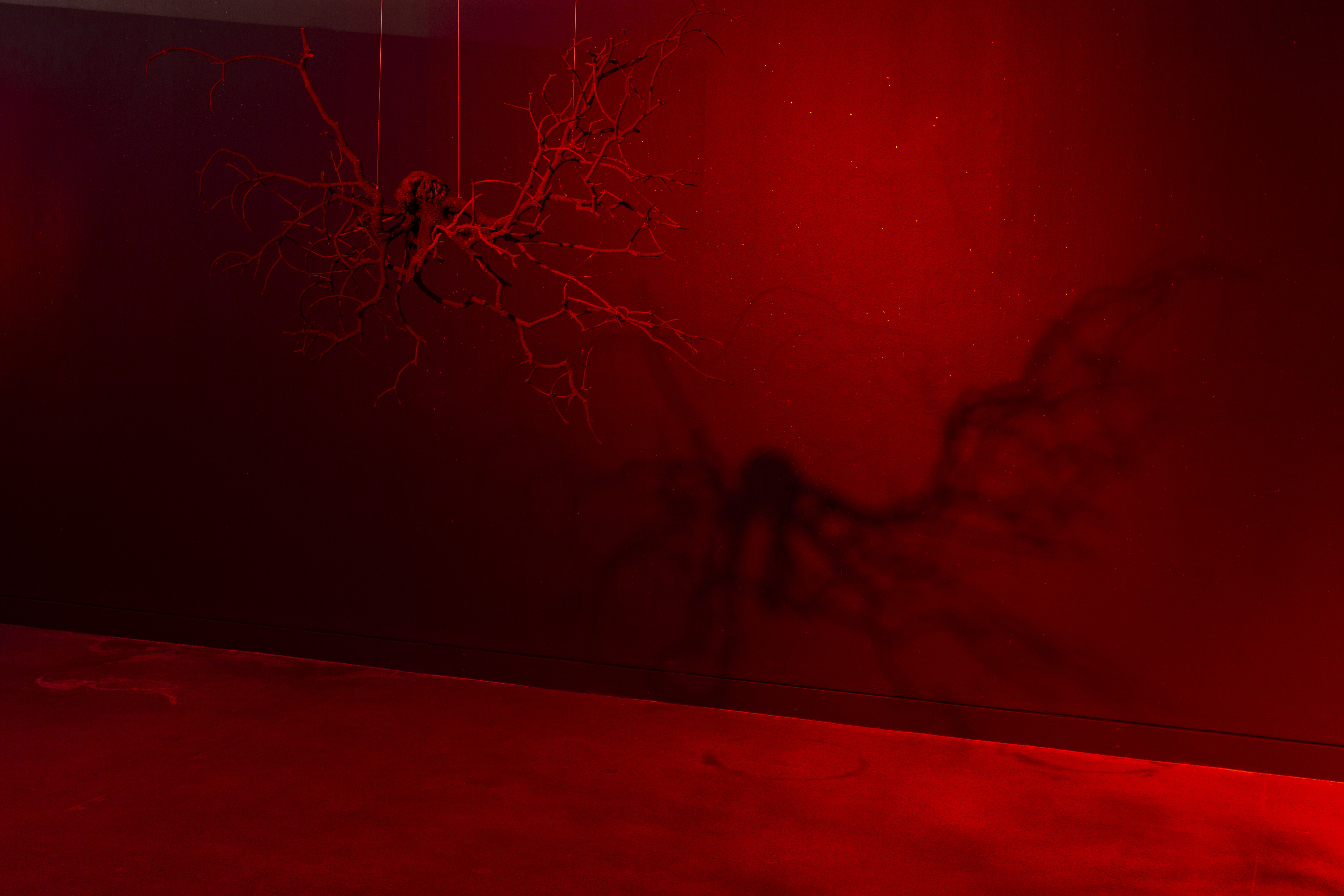
Maddison Gibbs, The Host, 2022. Sculptural and paint installation. Salllvage (Rowan Savage), Janyang/Gawal (in my tongue), 2022. Multi-channel soundscape. Nura: Deep Listening exhibition, curated by Dennis Golding. Commissioned by Cement Fondu. Photo: Jessica Maurer
I enter Nura: Deep listening, an exhibition by Maddison Gibbs, with accompanying audio work by salllvage (Rowan Savage) at Cement Fondu and feel a dry wracking overwhelm of emotion.
It was red, there was audio compiled of bush sounds, Indigenous language, and technological sounds. It was dark and vivisected trees with bulbous root balls, sinewy branches and clipped extremities were hung from the ceiling.
The visual language of The Host, was of theatre and fairy tales, carrying the cultural weight of mythic tales that shape the metanarrative. In this case the metanarrative leads us into Indigenous relationship to Country, the light and the dark, the damage and the healing. Sensorially immersive. one entered an environment where one’s responses became autonomic. Moving spotlights created shadows of suspended mistletoe branches that looked like sinewy arms with multiple elongated, gnarly fingers that traced themselves around the gallery walls, and anything else they encountered in the space – including me.
This emotional overwhelm that makes my breath painful to draw – has been happening to me since a few months after my mum died – halfway through this year. At unexpected and erratic times, the branchial tubes of my lungs become hypersensitive and – when I draw breath across them – it hurts – causing me to make involuntarily dry, wracking, sounds of loss. It first happened when on a chilly winter morning, I saw several homeless men in a row, all with no shoes on. It was like their vulnerability was too much to bear. Or did it cut too close to the bone? Did their visible vulnerability reveal the precarity of my own thinly held composure? My mum was always very reassuring to people doing it hard – it was her gift.
When I entered Nura, I was met by two gorgeous young women – gracious and hospitable – they effortlessly made me welcome – warm and inviting, their greeting included enough information so that I wouldn’t miss anything and the offer that I was welcome to return to them if I needed anything. Maybe, in this instance, in my aloneness, it was their grace that overwhelmed me: this is a possibility…
It could also have been the hanging, vivisected mistletoe limbs …or the intimate evocative soundscape. It could have been the shadows evoking childhood memories when the world was full of magic and menace. Menace that was thrilling and mostly ignited by our elastic imagination. Menace that was distant enough not to damage us – but not always.
I think, it was likely, a mixture of all these things and more. Kindness alongside traces of trauma in the suspended branches, carried by evocative sounds that subtly entered my body moving me into the interior territory of unarticulated subliminal memories – some personal, some cultural, always political. Some memories slide away as we try to retrieve them, eventually they become lost, irretrievable, and yet they are always colouring our relationship to the world, to ourselves and to each other.
Janyang/Gawal (in my tongue), the soundscape in Nura, create by, salllvage (Rowan Savage), is contextualised in the exhibition catalogue thus: Janyang/Gawal (in my tongue), ‘enacts and speaks to the ways in which the tools of a colonising society can be re-purposed to recreate connection in the face of alienation.’ It seems to me that at the heart of both Forever now and Nura, is a navigation of the contemporary malaise of disruption, disconnection, and alienation, whilst also evoking the possibility of change. Both exhibitions are undoubtedly beautiful, and both have returned to trouble and delight me.
I read somewhere … that there are two ways to live your life … as though nothing matters … or as though everything matters … I live a life of overwhelm and retreat … engagement with art offers me moments of respite along the way, mis-en-scenes that I write about in this blog as though they are interconnected stage sets of their own, where language is both my lifeline and my offering. My writing is my authentic contribution as a witness, to the art and its offer, considered and written as poethically as I can in this moment in time.
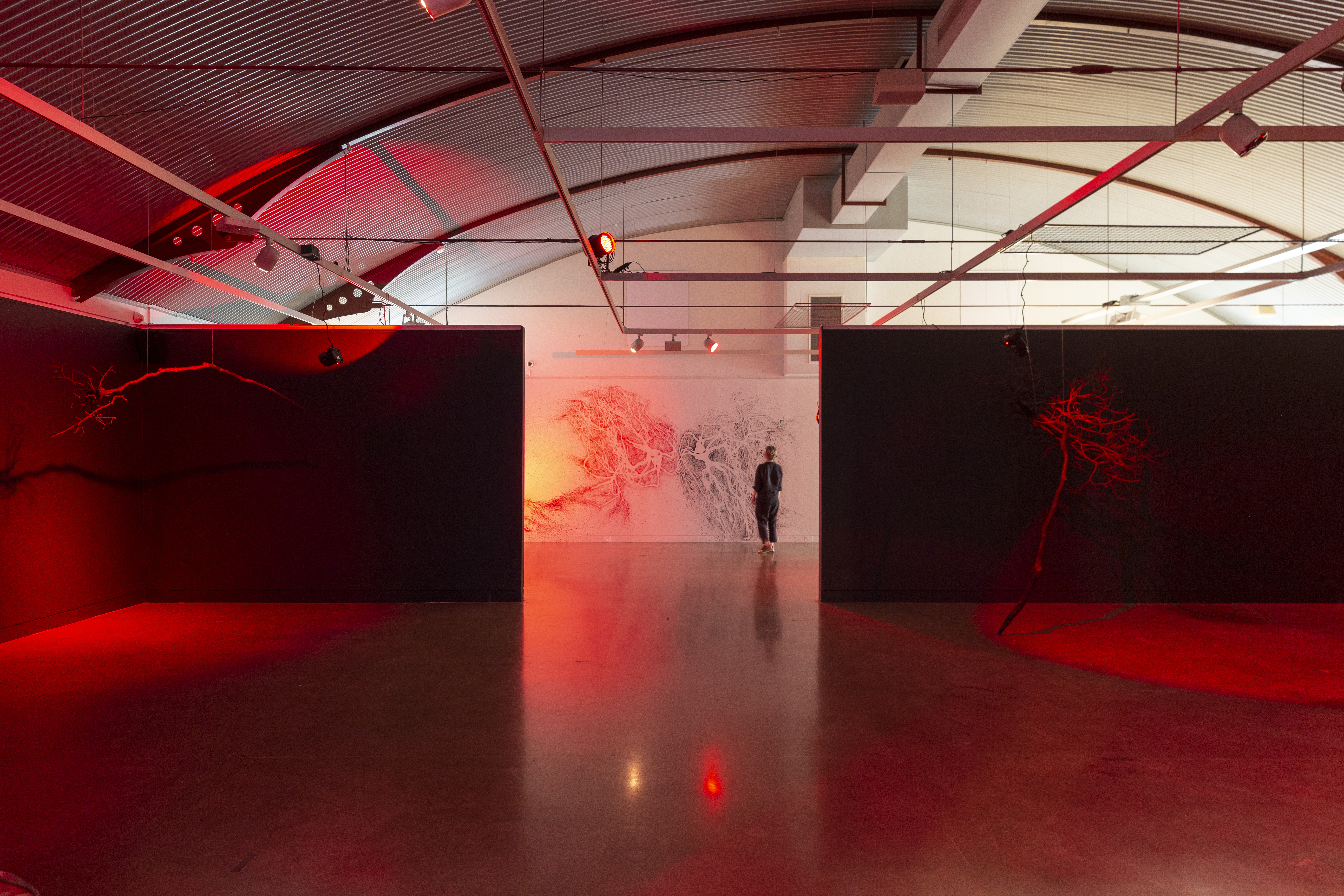
Maddison Gibbs, The Host, 2022. Sculptural and paint installation. Salllvage (Rowan Savage), Janyang/Gawal (in my tongue), 2022. Multi-channel soundscape. Nura: Deep Listening exhibition, curated by Dennis Golding. Commissioned by Cement Fondu. Photo: Jessica Maurer
 How to start a love affair with art
A lovely and thought provoking analysis of this piece – one I wouldn’t have encountered had I not taken a moment to read and engage with your work. Thank you for making the connection between this artwork and meaning so accessible.
Thanks for your comment Eva, I missed it when I wrote the blog post and only just spotted it now.
Thank you for taking the time to read my post and respond thoughtfully. 🌸
Pingback: Everything changes – a personal essay | How to start a love affair with art