
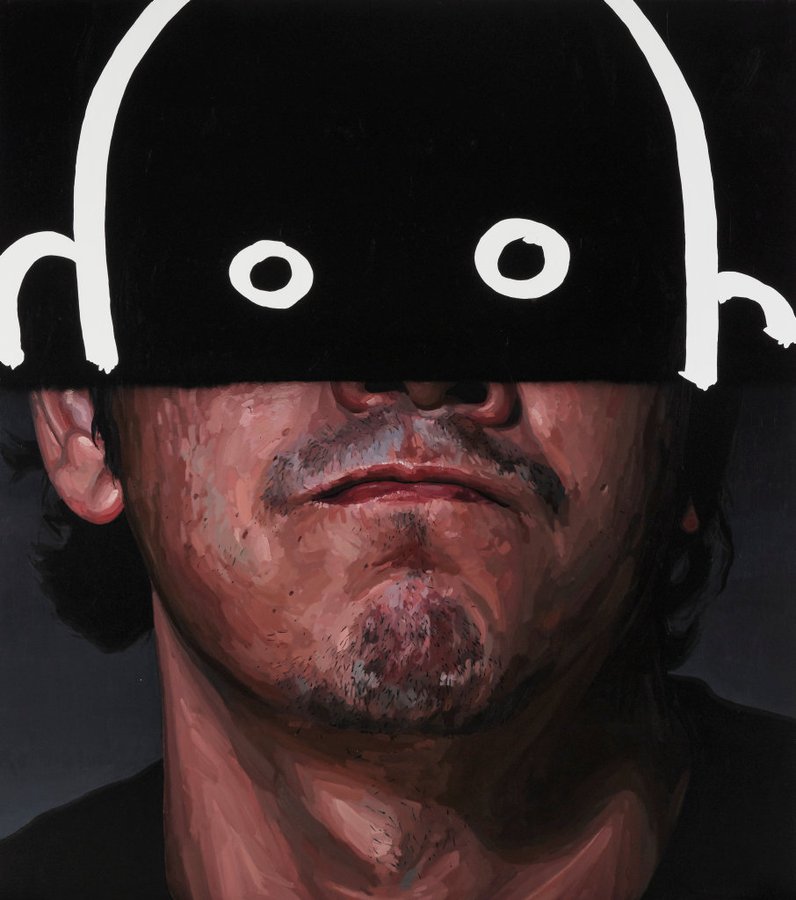
Abdul Abdullah, untitled self portrait, oil and aerosol on linen (2020) 183 x 163 cm.
An unrestrained response
This work is an untitled self-portrait by Abdul Abdullah.
It’s masculine.
It’s monumental.
It’s split in two.
The split is temporal, material, and conceptual.
In the first representational stage of the work, Abdullah’s head and neck are rendered realistically, albeit at a monumental scale of almost six feet tall. The artist’s sophisticated and well-observed palette captures the warm brown tones of his skin, with purples, blues, and greys in the shadows. It’s hard to decide if the attitude is pugnacious, defensive, or defeated. I’m leaning towards pugnacious but on another day, I might just as easily read it another way. Abdullah describes the portrait as “a version of myself that characterised a personal, chronic, sense of societal discomfort, before taking a $16 can of spray paint to cover it up.”
Cover it up.
Deface it.
Obliterate it.
Only to replace it …
with two simple white circle for eyes and two hooks for ears – cartoon like in their simplicity.
The black layer of spray paint drops like a shutter, grazing the peak of the nose and stopping at the nostrils. By removing the top half of the face, the intensity of the compressed mouth is unavoidable, wrinkling his chin which is sprinkled with black stubble. Curly black hair falls below the ear line and pushes the face forward from the grey background. A face pressed too close to the spray-painted intervention. An intervention that blocks the artist’s gaze and blocks our access to his eyes, making us the voyeur – the one who sees. Over the black spray paint the face is reduced to graphic white lines, removing the specificity of the original portrait turning the representation of the individual subject, Abdul Abdullah, into a symbol or a cipher – difficult to read.
Abdullah talks in his artists statement about his intentional defacing of the work as an act of agency. Abdullah’s work speaks to me of unknowability, both of one from the other, and of the self from the self. The splicing together of the traditional, illusory qualities of oil painting and the cartoon-like overpainting create a bothersome disturbance in the viewing and in the viewer. Due in equal parts to the actual act of defacement, and the psychologically disturbing suspicion, that we are being provoked to think for ourselves whilst not being given the full picture.
This painting springs from the Avant-garde refusal to submit, and resistance to succumb to the status quo. Within Abdullah’s own oeuvre this work is part of a trajectory of paintings where a lush, representational oil painting of people or scenes, is ‘defaced’ with figurative or text-based line work, often but not always in white. Identity and the representation of identity are not simple although we’d often like them to be. To disrupt a simple or singular reading of the self, or the situation is to destabilise others consumption of that self or that situated representation … curiously, this refusal to be singular still holds the power to disturb. Abdullah’s practice is both seductive with his luscious use of oil paint and, disturbing with his willful act of defacing his own work. Reminding us that we always have agency over our own actions and that exercising that agency is an inherently political act.
 How to start a love affair with art